
Influencer Marketing Trends in India 2026: 10 Trends Brands Need to Know
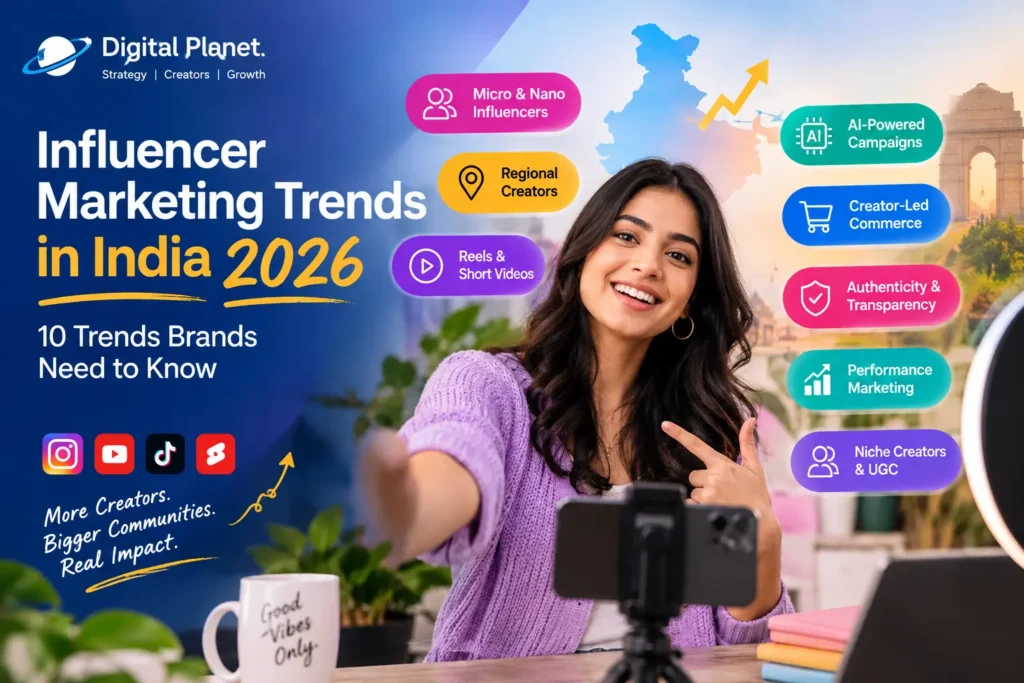
Influencer marketing in India is entering a new phase in 2026. What was once primarily about paying a popular creator to publish a sponsored post has evolved into a much broader marketing strategy involving content creation, community building, product discovery, UGC, affiliate commerce, performance marketing, AI and measurable conversions.
Indian consumers are increasingly discovering brands through short-form videos, creators and social platforms before making a purchase. Meta’s 2026 research indicates that Reels is playing a major role in India’s discovery and shopping journey, with 81% stronger product discovery and 47% influence on purchase decisions among surveyed users.
At the same time, India’s creator economy is becoming more professional. YouTube reported in 2026 that the number of Indian channels earning seven figures or more in revenue had increased by more than 20% year over year.
For brands, this means influencer marketing is no longer simply a branding exercise. It is increasingly becoming a full-funnel marketing channel.
So, what are the biggest influencer marketing trends in India in 2026, and how can brands use them to grow?
Let’s explore.
What Is Influencer Marketing?
Influencer marketing is a digital marketing strategy where brands collaborate with individuals who have an engaged audience on platforms such as Instagram, YouTube and other social networks.
Instead of communicating directly with consumers through traditional advertisements, brands work with creators who can introduce products or services through content that fits naturally into their existing audience and niche.
Influencer marketing can include:
- Instagram Reels
- Instagram Stories
- Instagram posts
- YouTube videos
- YouTube Shorts
- Product reviews
- Unboxing videos
- Tutorials
- UGC content
- Affiliate marketing
- Live streams
- Event appearances
- Brand collaborations
- Product launches
- Store visits
- Creator-led advertisements
In 2026, however, the biggest change is that brands are increasingly looking beyond follower counts.
Audience quality, authenticity, content quality, relevance and measurable business results are becoming more important than vanity metrics.
10 Biggest Influencer Marketing Trends in India 2026
1. Micro and Nano Influencers Are Becoming More Important
One of the biggest influencer marketing trends in India is the growing importance of micro and nano influencers.
Instead of spending an entire campaign budget on one celebrity or mega influencer, brands are increasingly distributing their budgets across multiple smaller creators.
Why?
Because smaller creators often have:
- Highly focused audiences
- Stronger community relationships
- Higher relevance within specific niches
- Local influence
- More authentic communication
- Better opportunities for repeated collaborations
Meta’s 2026 India research specifically highlights the role of micro and nano creators in reshaping trust and accelerating purchase decisions.
For example, a skincare brand may find that 20 carefully selected skincare micro influencers produce more useful content and audience engagement than one celebrity campaign.
Micro Influencers vs Nano Influencers
A nano influencer typically has a relatively small but highly engaged audience, while micro influencers generally have a larger niche following.
The important question isn’t:
“How many followers does this influencer have?”
Instead, brands should ask:
“Does this influencer have the right audience for my product?”
This shift from reach-first marketing to relevance-first marketing will be one of the defining trends of 2026.
2. Regional Influencer Marketing Is Exploding
India is not one single digital market.
It is a collection of thousands of communities, languages, cultures and consumer behaviours.
This makes regional influencer marketing one of the biggest opportunities for Indian brands.
Creators producing content in languages such as:
- Hindi
- Marathi
- Tamil
- Telugu
- Bengali
- Kannada
- Malayalam
- Gujarati
- Punjabi
- Bhojpuri
can help brands connect with audiences far beyond India’s major metros.
Meta’s 2026 research describes India’s video consumption as increasingly nationwide, with strong engagement across cities, towns and rural areas.
This means brands should not automatically limit their influencer campaigns to Mumbai, Delhi, Bengaluru or other major cities.
Tier-2 and Tier-3 cities are becoming important
Creators from smaller cities can offer something that national celebrities cannot always provide:
local trust.
A Marathi creator from Pune may be significantly more influential for a Maharashtra-focused campaign than a national celebrity with millions of followers.
Similarly, a Tamil creator may be better suited to a Tamil Nadu campaign than a generic pan-India creator.
The future is multilingual
Brands that build language-specific creator strategies can reach highly targeted communities while making their campaigns feel more natural and culturally relevant.
3. Reels Are Becoming a Major Commerce Engine
Short-form video is no longer just an entertainment format.
It is becoming part of the consumer buying journey.
Meta’s 2026 research found that Reels drives strong product discovery and purchase influence in India, with 81% stronger product discovery and 47% influence on purchase decisions in its surveyed data.
This makes Instagram Reels particularly valuable for:
- Fashion brands
- Beauty brands
- Skincare companies
- Food brands
- D2C businesses
- Fitness brands
- Jewellery companies
- Consumer electronics
- Travel businesses
- Lifestyle products
A successful Reel can take a consumer through multiple stages:
Discovery → Interest → Trust → Product Research → Purchase
This is why brands in 2026 should think beyond:
“Let’s get an influencer to post a Reel.”
Instead, the strategy should be:
“How can creator content move the consumer closer to purchase?”
4. Influencer Marketing Is Moving From Reach to Performance
For years, brands measured influencer campaigns using metrics such as:
- Followers
- Likes
- Comments
- Views
- Reach
These metrics are still useful, but brands increasingly want to understand the business impact of influencer marketing.
In 2026, marketers are paying greater attention to:
- Website visits
- Product page views
- Leads
- WhatsApp enquiries
- Coupon code usage
- Affiliate sales
- Add-to-cart activity
- Purchases
- Cost per acquisition
- Return on ad spend
- Conversion rate
- Revenue generated
This represents a major shift.
From:
“How many people saw the influencer’s post?”
To:
“How many qualified customers did the campaign generate?”
This is especially important for D2C and e-commerce brands.
A campaign with 500,000 views but zero purchases may be less valuable than a campaign with 100,000 highly relevant views that produces significant sales.
5. UGC and Influencer Marketing Are Converging
Another major trend in 2026 is the growing relationship between User-Generated Content (UGC) and influencer marketing.
UGC doesn’t necessarily require the creator to have a huge audience.
The creator’s primary value can be the content itself.
For example, a brand may hire a creator to produce:
- Product demonstration videos
- Testimonials
- Unboxing videos
- Before-and-after videos
- Problem-solution videos
- Product tutorials
- Lifestyle videos
- Voice-over videos
- Review videos
- Short-form advertisements
The brand can then use that content on:
- YouTube Shorts
- Meta Ads
- Product pages
- Websites
- Landing pages
This creates an important distinction:
Influencer Marketing
Audience + Influence + Content
UGC Marketing
Content + Authenticity + Advertising Assets
In 2026, smart brands will increasingly combine both.
6. AI Is Transforming Influencer Marketing
Artificial intelligence is rapidly becoming part of the influencer marketing workflow.
AI can help brands and agencies with:
- Influencer discovery
- Audience analysis
- Creator shortlisting
- Content ideation
- Campaign planning
- Caption generation
- Performance analysis
- Fraud detection
- Reporting
- Content repurposing
- Trend identification
AI is also becoming increasingly relevant to creators themselves.
A 2026 report cited by Times of India found that 97% of surveyed Indian creators said GenAI had positively affected their creative growth.
However, AI should not replace human creativity.
The most successful campaigns will likely combine:
AI efficiency + human creativity + creator authenticity.
AI-generated influencers: opportunity or risk?
Brands are also experimenting with AI-generated influencers and synthetic content.
But this comes with an important challenge: consumer trust.
If audiences believe they are watching a genuine person or genuine testimonial when the content is actually synthetic, brands risk damaging credibility.
Therefore, responsible AI usage, transparency and authentic creator partnerships will become increasingly important.
7. Creator-Led Commerce Is the Next Big Opportunity
Influencers are increasingly becoming more than promotional channels.
They are becoming commerce drivers.
YouTube has been expanding shopping-related creator features in India. In 2025, YouTube reported that more than 200 million logged-in users in India had conducted shopping-related searches on the platform, while shopping-related watch time had grown by more than 250% year over year.
This shows the enormous commercial potential of creator-led discovery.
A creator can influence the consumer journey through:
Content → Product Discovery → Recommendation → Consideration → Purchase
This can happen through:
- Affiliate links
- Creator storefronts
- Discount codes
- Product tags
- Shopping integrations
- Direct website links
- WhatsApp conversations
- Live shopping
- Product demonstrations
For e-commerce businesses, this means influencer marketing can become much closer to a sales channel.
8. Long-Term Influencer Partnerships Will Beat One-Off Posts
Brands are increasingly realizing that one sponsored post is rarely enough to build strong consumer trust.
Instead, long-term partnerships allow creators to become genuine brand advocates.
For example, instead of:
One influencer + one Reel + one payment
a brand could build:
3-month creator partnership + multiple Reels + Stories + UGC + product launches + affiliate sales
This creates consistency.
The audience repeatedly sees the creator using or discussing the brand.
That can make the partnership feel more natural and credible.
Long-term collaborations can also help brands:
- Build stronger creator relationships
- Negotiate better rates
- Produce more consistent content
- Understand audience response
- Improve campaign performance
- Create creator ambassadors
The broader global influencer marketing conversation in 2026 is similarly shifting toward deeper, longer-term creator relationships rather than purely transactional posts.
9. Niche Influencers Are Becoming More Valuable
Another important trend is the rise of niche creators.
Instead of choosing a creator simply because they have millions of followers, brands are increasingly asking whether the creator has authority in a specific category.
Examples include:
- Personal finance creators
- Fitness creators
- Skincare creators
- Parenting creators
- Food creators
- Tech creators
- Automobile creators
- Fashion creators
- Travel creators
- Education creators
- Gaming creators
- Business creators
A finance creator with 100,000 highly relevant followers may be more valuable for a financial product than a general entertainment creator with 2 million followers.
The formula is changing
Old approach:
More followers = better influencer
New approach:
Relevant audience + trust + content quality + engagement + conversion potential = better influencer
10. Authenticity and Transparency Will Matter More Than Ever
The influencer industry is becoming more professional, which means brands need stronger standards around transparency.
Consumers are becoming increasingly capable of recognizing overly scripted advertising.
This makes authentic storytelling extremely important.
Instead of giving creators a script containing every sentence they must say, brands can provide:
- Campaign objective
- Key product benefits
- Mandatory claims
- Do’s and don’ts
- Brand guidelines
- Disclosure requirements
Then allow the creator to communicate in their own voice.
This can make branded content feel more natural.
Authenticity doesn’t mean lack of strategy
A good influencer campaign should have:
Clear strategy + creator freedom + authentic storytelling.
The goal is not to make the content look like a traditional advertisement.
The goal is to make the brand message fit naturally into content the audience already enjoys.
Influencer Marketing Platforms That Brands Should Focus On in 2026
Different platforms serve different marketing objectives.
Best for:
- Reels
- Fashion
- Beauty
- Lifestyle
- Food
- Fitness
- D2C
- Product discovery
- Visual storytelling
Instagram should remain a major priority for consumer brands because of the growing role of Reels in India’s discovery and commerce journey.
YouTube
Best for:
- Product reviews
- Tutorials
- Technology
- Finance
- Education
- Long-form storytelling
- Product comparisons
- Shopping intent
YouTube’s creator ecosystem has become a significant economic force in India. Google reported that YouTube’s creative ecosystem contributed more than ₹16,000 crore to India’s GDP and supported more than 930,000 full-time-equivalent jobs in the latest Oxford Economics assessment cited by Google.
YouTube Shorts
Best for:
- Short-form discovery
- Viral content
- Product awareness
- Creator storytelling
- Younger audiences
Still relevant for:
- Regional audiences
- Community-driven content
- Older demographics
- Local businesses
- Tier-2 and Tier-3 markets
The future isn’t necessarily about choosing one platform.
It is about building multi-platform creator campaigns.
How Brands Can Build an Influencer Marketing Strategy in 2026
Following trends is not enough.
Brands need a structured strategy.
Step 1: Define Your Objective
Decide whether the campaign is designed for:
- Brand awareness
- Product launch
- Lead generation
- Website traffic
- App installs
- Sales
- Store visits
- UGC creation
- Community building
Step 2: Identify Your Target Audience
Define:
- Age
- Gender
- Location
- Language
- Interests
- Buying behaviour
- Income level
- Platform preferences
Step 3: Choose the Right Influencer Type
Depending on your objective, consider:
- Nano influencers
- Micro influencers
- Mid-tier influencers
- Macro influencers
- Celebrity influencers
- UGC creators
- Regional creators
- Niche creators
Step 4: Evaluate Influencers Beyond Followers
Check:
- Engagement rate
- Audience demographics
- Audience location
- Content quality
- Previous brand collaborations
- Comment quality
- Fake follower indicators
- Content consistency
- Brand relevance
- Conversion history
Step 5: Create a Strong Campaign Brief
Your campaign brief should clearly communicate:
- Campaign objective
- Product information
- Target audience
- Key message
- Deliverables
- Timeline
- Content guidelines
- Mandatory disclosures
- Usage rights
- Payment terms
But avoid controlling every word the creator says.
Step 6: Track Performance
Monitor:
Awareness Metrics
- Reach
- Impressions
- Video views
Engagement Metrics
- Likes
- Comments
- Shares
- Saves
Traffic Metrics
- Link clicks
- Website visits
- Landing-page sessions
Conversion Metrics
- Leads
- Purchases
- Coupon codes
- Affiliate sales
- Revenue
- ROAS
Influencer Marketing Trends vs Traditional Advertising
Influencer marketing has a unique advantage: it combines content, distribution and social proof.
Traditional advertising generally places the brand directly in front of consumers.
Influencer marketing can introduce the brand through a person the consumer already follows.
This can make the message feel more relatable.
However, influencer marketing isn’t automatically better than traditional advertising.
The strongest marketing strategy often combines:
Influencer Marketing + UGC + Paid Social + Performance Marketing + Retargeting + SEO + Content Marketing
This creates a complete digital marketing funnel.
Why Influencer Marketing Will Continue Growing in India
Several factors are driving the growth of influencer marketing in India:
1. Smartphone penetration
More consumers are consuming video content on mobile devices.
2. Short-form video
Reels and Shorts have made content discovery faster.
3. Regional-language content
Consumers increasingly engage with content in their preferred languages.
4. Creator trust
People often follow creators because they feel connected to their personality and expertise.
5. E-commerce growth
Creator recommendations can directly influence product discovery.
6. AI
AI is making creator discovery, content production and campaign management more efficient.
7. Better measurement
Brands can increasingly connect influencer activity with measurable outcomes.
8. Creator professionalization
Creators are increasingly operating like businesses rather than casual social media personalities.
The Future of Influencer Marketing in India
The future of influencer marketing in India will not simply be about finding people with large audiences.
It will be about finding the right creators for the right communities at the right stage of the customer journey.
We are likely to see more:
- AI-powered influencer discovery
- Micro and nano creator campaigns
- Regional-language campaigns
- Creator-led commerce
- Affiliate influencer marketing
- UGC-powered advertising
- Long-term creator partnerships
- Performance-based influencer campaigns
- Multi-platform creator strategies
- Data-driven campaign optimization
India’s creator ecosystem is already moving toward greater professionalization. A 2026 report cited by Economic Times projects India’s influencer marketing industry could reach ₹5,000 crore by 2027, driven by factors including creator professionalization, AI-powered efficiencies, accountability and regulation.
The result is a more mature influencer marketing ecosystem where brands will increasingly demand measurable business outcomes, not just impressive follower counts.
Final Thoughts
Influencer Marketing in India is no longer just about influence. It is about impact.
In 2026, the winning brands will be those that understand how to combine:
Creators + Content + Community + AI + Data + Commerce
Micro and nano influencers will help brands build trust. Regional creators will help brands reach India’s diverse communities. Reels and Shorts will drive discovery. UGC will provide authentic advertising content. AI will improve efficiency. Affiliate and creator-led commerce will connect influence with sales.
Most importantly, brands will increasingly move away from asking:
“How many followers does this influencer have?”
and start asking:
“Can this creator influence the right audience and help us achieve our business objective?”
That is the real direction of influencer marketing in India in 2026.
Looking for an Influencer Marketing Partner in India?
At Digital Planet, we help brands plan and execute influencer marketing campaigns designed around their business objectives.
From influencer discovery and creator selection to campaign planning, content creation, execution and performance tracking, a strategic approach can help brands turn creator partnerships into measurable marketing outcomes.
Whether you are looking for:
- Instagram Influencer Marketing
- YouTube Influencer Marketing
- Micro Influencer Campaigns
- Regional Influencer Marketing
- UGC Content
- Celebrity Marketing
- Product Launch Campaigns
- Brand Awareness Campaigns
- Performance Influencer Marketing
- Creator-Led Campaigns
the right strategy starts with choosing the right creators and defining the right objective.
Ready to make influence work for your brand? Connect with Digital Planet and plan your next influencer marketing campaign.
Frequently Asked Questions
What are the biggest influencer marketing trends in India in 2026?
The major trends include micro and nano influencers, regional creators, short-form video, UGC, AI-powered influencer marketing, creator-led commerce, performance-based campaigns, niche creators and long-term brand partnerships.
Is influencer marketing effective in India?
Yes. Influencer marketing is increasingly becoming an important part of brand discovery and purchase journeys in India. Meta’s 2026 research found strong consumer influence from Reels across discovery and purchasing behaviour.
Are micro influencers better than celebrity influencers?
Not necessarily. The right choice depends on the campaign objective. Micro influencers can be particularly useful when brands need niche relevance, engagement and community trust, while celebrities can provide large-scale awareness.
What is the role of AI in influencer marketing?
AI can assist with influencer discovery, audience analysis, campaign planning, content ideation, reporting, optimization and fraud detection. However, human creativity and authentic creator relationships remain essential.
Is Instagram still important for influencer marketing in 2026?
Yes. Instagram Reels remains a major creator-discovery and shopping surface in India, particularly for categories such as fashion, beauty, lifestyle, fitness and e-commerce.
Why are regional influencers important in India?
Regional influencers can help brands communicate with consumers in local languages and cultural contexts. This is particularly valuable when targeting Tier-2, Tier-3 and regional markets.
What is UGC in influencer marketing?
UGC, or User-Generated Content, refers to creator-style content produced around a product or service. Unlike traditional influencer marketing, UGC does not necessarily depend on the creator’s audience size. Brands can use UGC as organic social content or as paid advertising creative.
How can brands measure influencer marketing ROI?
Brands can measure ROI using metrics such as website traffic, leads, purchases, affiliate sales, coupon-code usage, conversion rate, customer acquisition cost and revenue generated, alongside awareness and engagement metrics.
What type of influencer should a brand choose?
The best influencer depends on the campaign objective, target audience, location, niche, budget and desired outcome. Follower count alone should not determine influencer selection.