
How Much Does Influencer Marketing Cost in India in 2026?
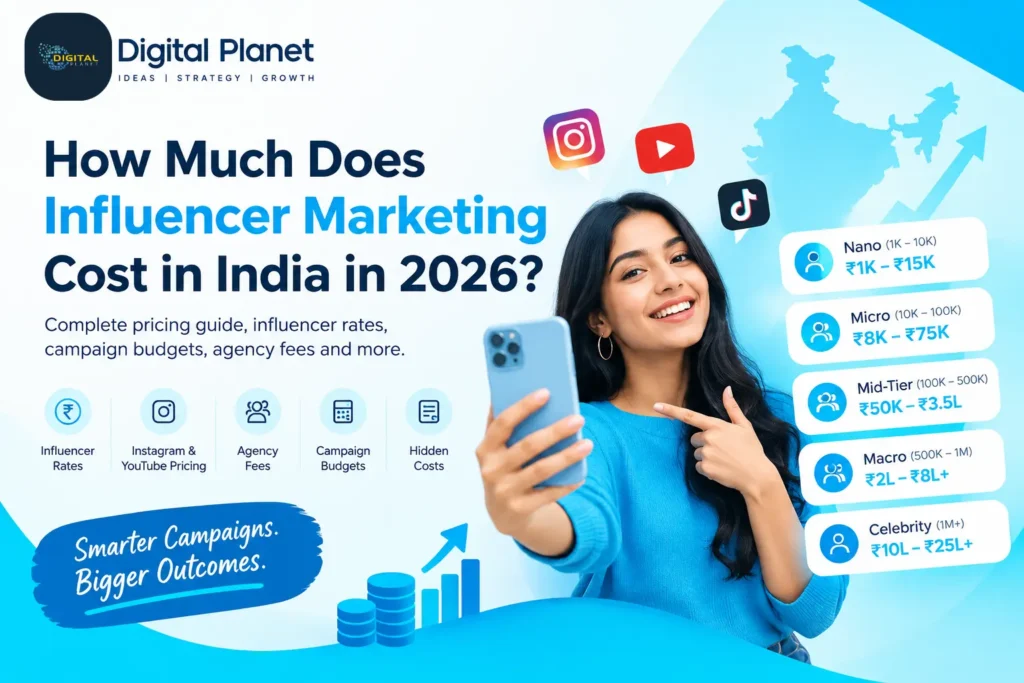
How much does influencer marketing cost in India in 2026? This is one of the first questions brands ask before launching an influencer campaign—and there is no single fixed answer.
In 2026, influencer marketing costs in India can range from ₹1,000–₹15,000 for nano creators to ₹10 lakh or more for celebrity-level collaborations, depending on the creator’s audience size, engagement, niche, platform, content format, usage rights, exclusivity and campaign requirements.
For most brands, however, the biggest opportunity lies somewhere between the extremes. Micro and mid-tier influencers can allow brands to build targeted reach, credibility and content at significantly different budgets than celebrity campaigns.
Recent industry research also indicates that India’s influencer marketing ecosystem is becoming increasingly structured. Kofluence’s 2025–26 report estimates India’s annual influencer marketing spend at around ₹3,500 crore in 2026, while reporting increased use of formal contracts, performance measurement and long-term creator partnerships.
In this guide, Digital Planet breaks down influencer marketing costs in India in 2026, including Instagram and YouTube rates, influencer categories, agency fees, hidden costs, sample campaign budgets and practical tips for getting better value from your influencer marketing investment.
Quick Answer: How Much Does Influencer Marketing Cost in India in 2026?
As a broad 2026 market benchmark, brands may encounter the following approximate creator rates:
| Influencer Type | Followers | Approx. Instagram Reel Cost | Approx. YouTube Cost |
|---|---|---|---|
| Nano Influencer | 1K–10K | ₹1,000–₹15,000 | ₹2,000–₹25,000+ |
| Micro Influencer | 10K–100K | ₹8,000–₹75,000 | ₹10,000–₹1,00,000+ |
| Mid-Tier Influencer | 100K–500K | ₹50,000–₹3,50,000 | ₹1,00,000–₹4,00,000+ |
| Macro Influencer | 500K–1M | ₹2,00,000–₹8,00,000+ | ₹4,00,000–₹15,00,000+ |
| Mega/Celebrity | 1M+ | ₹6,00,000–₹25,00,000+ | ₹15,00,000–₹1 Crore+ |
Important: These are indicative market ranges, not fixed rate cards. Actual quotes can vary considerably based on niche, audience quality, engagement, content requirements, exclusivity, usage rights, creator demand and campaign timing. Published 2026 benchmarks from several industry sources show similarly wide ranges.
What Is Influencer Marketing?
Influencer marketing is a digital marketing strategy where brands collaborate with content creators who have an established audience on platforms such as:
- YouTube
- Snapchat
- Moj
- Josh
- Other regional and emerging platforms
Instead of communicating directly with consumers through traditional advertising alone, brands use creators to introduce products, services or campaigns through content that fits the creator’s usual style.
A collaboration may include:
- Instagram Reels
- Instagram Stories
- Static posts
- YouTube Shorts
- YouTube integrations
- Dedicated YouTube videos
- Product reviews
- Unboxing videos
- Tutorials
- UGC content
- Event coverage
- Store visits
- Affiliate campaigns
- Brand ambassador partnerships
The cost depends heavily on what the creator is expected to deliver.
Why Is Influencer Marketing Growing in India?
India has one of the world’s largest digital and social media audiences. Reuters reported in January 2026 that India had approximately 500 million unique social media users, with YouTube and Instagram each approaching 500 million users based on available 2025 data.
At the same time, India’s creator ecosystem is expanding beyond major metropolitan cities. Recent reporting based on research from the Indian School of Business and HashFame found that nearly two-thirds of Indian creators now come from non-metro regions.
This creates opportunities for brands targeting:
- Tier-1 cities
- Tier-2 cities
- Tier-3 cities
- Regional-language audiences
- Hyperlocal consumers
- Specific communities and interests
For brands, influencer marketing is therefore no longer limited to celebrity endorsements.
A campaign can involve 10 highly relevant micro creators, 100 nano creators, one regional celebrity or a combination of multiple creator categories.
Influencer Marketing Cost in India by Influencer Tier
1. Nano Influencers: 1K–10K Followers
Nano influencers typically have smaller but highly focused communities.
Approximate 2026 cost:
₹1,000–₹15,000 per Instagram content collaboration
Some nano creators may also accept:
- Free products
- Product + small fee
- Affiliate commissions
- Product exchange campaigns
Published 2026 rate benchmarks place nano Instagram Reel pricing broadly within this range, although quotes differ considerably between creators and categories.
Suitable for:
- Local businesses
- Restaurants
- Salons
- Gyms
- Startups
- D2C brands
- Product seeding
- Regional campaigns
- Community marketing
Example
Instead of spending ₹2 lakh on one large creator, a brand could potentially work with dozens of relevant nano creators.
The objective changes from one large audience to many smaller communities.
2. Micro Influencers: 10K–100K Followers
Micro influencers are one of the most frequently considered creator categories for Indian brand campaigns.
Typical 2026 Instagram Reel benchmarks range from approximately:
₹8,000–₹75,000 per Reel
with actual quotes varying significantly based on creator quality and category.
Micro influencers can be particularly useful for:
- Fashion
- Beauty
- Food
- Fitness
- Finance
- Technology
- Parenting
- Travel
- Lifestyle
- Education
- Regional content
Why brands consider micro creators
A creator with 40,000 highly relevant followers may be commercially more useful for a niche campaign than a much larger creator whose audience does not match the target customer.
Therefore, brands should evaluate:
Audience relevance + engagement + content quality + geography + conversion potential
rather than followers alone.
3. Mid-Tier Influencers: 100K–500K Followers
Mid-tier creators provide a combination of reach and creator credibility.
Typical Instagram Reel benchmarks can range around:
₹50,000–₹3,50,000+
depending on the creator, niche and campaign requirements.
These creators can be useful for:
- Product launches
- App promotions
- Brand awareness
- Fashion campaigns
- Technology campaigns
- Financial services
- Automobile campaigns
- Travel campaigns
- Large D2C launches
At this level, brands should pay particular attention to audience demographics and previous brand collaborations.
4. Macro Influencers: 500K–1M Followers
Macro influencers offer substantially larger potential reach.
A typical 2026 Instagram Reel can cost approximately:
₹2 lakh–₹8 lakh+
while YouTube integrations can cost considerably more depending on channel size and deliverables.
Macro creators are commonly considered for:
- Mass awareness
- Major product launches
- Large consumer brands
- Entertainment campaigns
- National campaigns
- Seasonal campaigns
However, a larger audience does not automatically guarantee better campaign performance.
5. Mega Influencers and Celebrities
Celebrity and mega-influencer campaigns occupy the highest end of the pricing spectrum.
Depending on the celebrity, platform, popularity, category and deliverables, costs can reach:
₹10 lakh to ₹25 lakh+ per Instagram collaboration, with some celebrity partnerships going substantially higher.
YouTube or multi-platform campaigns can command even higher budgets.
Some 2026 market benchmarks place celebrity-level Instagram collaborations from several lakh rupees to ₹25 lakh or more, while other market estimates extend into much higher ranges for top-tier talent.
Celebrity campaigns can provide significant visibility, but brands should clearly define whether the objective is:
- Awareness
- Reach
- Brand association
- Product launch
- Credibility
- Sales
- Content creation
The right creator depends on the campaign objective.
Instagram Influencer Marketing Cost in India 2026
Instagram remains one of the most important platforms for influencer campaigns in India.
Approximate 2026 ranges are:
| Instagram Deliverable | Approximate Cost |
|---|---|
| Nano Reel | ₹1,000–₹15,000 |
| Micro Reel | ₹8,000–₹75,000 |
| Mid-Tier Reel | ₹50,000–₹3.5 Lakh |
| Macro Reel | ₹2–₹8 Lakh+ |
| Story | Usually lower than Reel |
| Static Post | Usually lower than Reel |
| Multi-Reel Campaign | Negotiated package |
| Usage Rights | Additional cost may apply |
Reels generally command higher rates than simple static content because they require greater production effort and potentially provide greater distribution.
Some published 2026 benchmarks indicate that Stories may be priced at a fraction of Reel rates, while usage rights and paid amplification can increase the overall cost.
YouTube Influencer Marketing Cost in India 2026
YouTube pricing is different from Instagram because the content-production process can be significantly more involved.
A YouTube collaboration could involve:
YouTube Integration
The creator mentions or demonstrates the brand within an existing video.
Dedicated Video
The entire video is created around the brand or product.
YouTube Shorts
Short-form content designed for YouTube’s Shorts format.
Approximate 2026 ranges
| Creator Level | YouTube Integration / Video |
|---|---|
| Nano | ₹2,000–₹25,000+ |
| Micro | ₹10,000–₹1 Lakh+ |
| Mid-Tier | ₹1–₹4 Lakh+ |
| Macro | ₹4–₹15 Lakh+ |
| Large/Mega | ₹15 Lakh–₹1 Crore+ |
These should be treated as broad planning benchmarks rather than guaranteed prices. Creator niche, average views, production quality, audience geography and deliverable type can significantly change the quote.
What Factors Affect Influencer Marketing Cost in India?
Two creators with the same follower count can charge completely different amounts.
Here are the major factors affecting influencer marketing pricing in 2026.
1. Number of Followers
Follower count remains an important pricing reference.
However, it is not the only factor.
A 50K-follower creator with an active and relevant audience can be more valuable for a particular campaign than a 500K-follower creator with low audience relevance.
2. Engagement Rate
Engagement is one of the most important factors.
Brands should examine:
- Likes
- Comments
- Shares
- Saves
- Views
- Story interactions
- Average Reel views
- Audience response
Don’t judge a creator solely by their follower count.
3. Content Format
Different formats have different production requirements.
For example:
Static Post < Story < Reel < YouTube Integration < Dedicated Video
This is not a universal pricing rule, but production complexity generally increases as the content requirements become more demanding.
4. Influencer Niche
Specialised creators may charge different rates depending on demand and audience value.
Examples include:
- Finance
- Technology
- Beauty
- Fashion
- Healthcare
- Fitness
- Gaming
- Travel
- Food
- Automotive
- Business
A highly specialised audience can be commercially valuable because the creator reaches a specific consumer segment.
5. Audience Location
A creator’s audience geography matters significantly.
For example, a Pune-based restaurant may gain more value from creators whose audience is concentrated in Pune than from a creator with a much larger but nationally dispersed audience.
Similarly, a national D2C brand may prioritize creators with audiences across multiple Indian states.
6. Language
India’s regional creator ecosystem is growing rapidly.
Brands can now build campaigns in:
- Hindi
- Marathi
- Tamil
- Telugu
- Kannada
- Bengali
- Malayalam
- Gujarati
- Punjabi
- English
- Hinglish
This allows brands to build highly localized influencer campaigns.
7. Usage Rights
This is one of the most overlooked costs.
Suppose a creator produces a Reel for your brand.
You may want to:
- Repost it on your Instagram
- Use it on your website
- Use it in Meta Ads
- Use it on YouTube
- Use it in an app
- Use it on Amazon
- Use it for six months
- Use it indefinitely
These rights may require additional payment.
What Are Influencer Usage Rights?
Usage rights determine where and for how long a brand can use creator-produced content.
For example:
Organic Usage
The brand can publish the creator’s content on its own social media channels.
Paid Usage
The brand can use the creator’s content in advertising.
Whitelisting / Partnership Advertising
The creator’s identity or account may be used to support paid distribution, depending on the platform and agreement.
Extended Usage
The brand can continue using the content for an agreed period.
These terms should be clearly documented before the campaign begins.
Industry pricing guides commonly identify usage rights and paid amplification as factors that can materially increase creator fees.
Influencer Exclusivity Charges
Suppose a skincare brand hires a creator.
The brand may ask:
“Please don’t promote a competing skincare brand for the next 60 days.”
That’s an exclusivity clause.
Because the creator is giving up potential income from competing brands, exclusivity can increase the campaign price.
The final agreement should specify:
- Competitor definition
- Exclusivity duration
- Product category
- Geography
- Platform
- Start and end dates
Influencer Marketing Agency Fees in India
Creator fees are not necessarily the complete campaign cost.
If you hire an influencer marketing agency, your campaign may also include:
- Strategy
- Influencer discovery
- Creator shortlisting
- Negotiation
- Briefing
- Contracts
- Content coordination
- Approval management
- Campaign tracking
- Reporting
- Payment management
- Performance analysis
Agency pricing models vary.
Published 2026 industry estimates show agency fees can be structured as 15%–25% of creator spend, fixed project fees or monthly retainers, depending on the scope.
Example
If creator fees total:
₹3,00,000
and the agency charges 20%:
Agency fee = ₹60,000
Your pre-tax campaign cost becomes:
₹3,60,000
Other costs may apply depending on the agreement.
Always ask an agency:
“Is this quote inclusive of creator fees, agency fees, production, GST, usage rights and paid amplification?”
How Much Budget Do You Need for Influencer Marketing?
There is no universal minimum budget.
Your budget should depend on your objective.
₹25,000–₹50,000 Budget
Suitable for:
- Small local campaigns
- Product seeding
- Nano creators
- A few micro creators
- Testing creator content
Possible strategy:
5–10 highly relevant nano/micro creators.
₹50,000–₹1 Lakh Budget
Suitable for:
- Local brands
- Small D2C campaigns
- Product launches
- UGC campaigns
- Regional campaigns
The focus should be on testing multiple creators rather than spending the entire budget on one account.
₹1 Lakh–₹3 Lakh Budget
This is a practical range for a structured small-to-medium influencer campaign.
Possible approach:
- 10–20 micro creators
- Combination of nano + micro creators
- Regional creators
- Reels + Stories
- UGC content
- Performance tracking
Some 2026 industry estimates place properly managed starter campaigns with multiple creators in roughly this range, although scope varies substantially.
₹3 Lakh–₹10 Lakh Budget
This allows a brand to consider:
- Mid-tier creators
- Larger creator combinations
- Multiple cities
- Regional campaigns
- YouTube + Instagram
- Paid amplification
- More sophisticated tracking
₹10 Lakh+ Budget
Brands with larger budgets can build:
- National campaigns
- Celebrity campaigns
- Multi-platform campaigns
- Large creator networks
- Product launches
- Long-term ambassador programs
- Always-on influencer programs
Sample Influencer Marketing Campaign Budget
Let’s consider a hypothetical D2C beauty brand with a ₹3 lakh influencer marketing budget.
Example Campaign
| Activity | Estimated Budget |
|---|---|
| 10 Micro Creators | ₹1,20,000 |
| 3 Mid-Tier Creators | ₹90,000 |
| Content/UGC Production | ₹30,000 |
| Campaign Management | ₹40,000 |
| Tracking & Reporting | ₹10,000 |
| Contingency | ₹10,000 |
| Total | ₹3,00,000 |
This is only an illustrative structure. Actual creator quotations can vary considerably.
The important principle is to avoid allocating 100% of the budget to creator fees.
Influencer Marketing Cost vs Traditional Advertising
Influencer marketing and traditional digital advertising serve different purposes.
| Factor | Influencer Marketing | Traditional Digital Ads |
|---|---|---|
| Audience | Creator’s community | Targeted audience |
| Content | Creator-led | Brand-led |
| Trust | Can benefit from creator relationship | Depends on ad creative |
| Targeting | Audience/community based | Highly configurable |
| Content Production | Often included in collaboration | Usually separate |
| Measurement | Can track links, codes, views and conversions | Strong platform-level measurement |
| Scalability | Depends on creator network | Highly scalable |
| Cost | Highly variable | Highly variable |
Many brands use both approaches together.
For example:
Creator content → Organic posting → Paid amplification → Landing page → Conversion tracking
This can turn influencer content into a broader performance marketing asset.
How to Calculate Influencer Marketing ROI
Don’t simply ask:
“How many followers did the influencer have?”
Instead, measure campaign outcomes.
Important KPIs include:
Awareness
- Reach
- Impressions
- Video views
- Unique viewers
Engagement
- Likes
- Comments
- Shares
- Saves
- Engagement rate
Traffic
- Link clicks
- Website sessions
- Landing-page visits
Sales
- Purchases
- Revenue
- Coupon-code usage
- Cost per acquisition
- Conversion rate
Content
- Number of usable assets
- Content quality
- Reusable UGC
- Paid-ad performance
CPM and Cost Per View in Influencer Marketing
Brands can also compare influencer campaigns using media-style metrics.
CPM
CPM = Total Campaign Cost ÷ Impressions × 1,000
Example:
If you spend ₹1,00,000 and generate 10 lakh impressions:
CPM = ₹100
Cost Per View
CPV = Total Campaign Cost ÷ Video Views
If a campaign costs ₹1,00,000 and receives 5 lakh views:
CPV = ₹0.20
These metrics can help compare creator campaigns more objectively.
Why Follower Count Is Not Enough in 2026
One of the biggest influencer marketing mistakes is choosing creators based purely on followers.
Consider two hypothetical creators:
Creator A
- 500,000 followers
- 0.8% engagement
- Audience spread across multiple countries
- Low relevance to your product
Creator B
- 50,000 followers
- Strong engagement
- 85% Indian audience
- 60% of audience matches your target customer
- Strong historical content performance
For a specific Indian D2C campaign, Creator B may have stronger audience alignment.
The point is not that smaller creators are always better.
The point is:
The right creator should be selected according to campaign objectives—not follower count alone.
Hidden Costs in Influencer Marketing
Before approving your budget, check for these additional costs.
1. GST
Applicable taxes should be considered when calculating the final campaign budget.
2. Agency Fees
May be charged as:
- Percentage
- Fixed project fee
- Monthly retainer
3. Content Production
Professional shoots, editing, models, locations or props may increase the budget.
4. Usage Rights
Paid advertising or extended content usage can require additional fees.
5. Exclusivity
Restricting creators from working with competitors can increase costs.
6. Travel
Events, store visits and physical activations may involve travel expenses.
7. Product Costs
For product-based campaigns, brands should account for:
- Product samples
- Shipping
- Packaging
- Returns
8. Paid Amplification
If you want to boost creator content through paid advertising, keep a separate media budget.
How to Reduce Influencer Marketing Costs
Lowering cost does not necessarily mean negotiating the creator’s fee down as much as possible.
Instead, improve the value you receive from the collaboration.
1. Work With Multiple Relevant Creators
Instead of putting the entire budget into one creator, test several creators.
2. Negotiate Packages
For example:
1 Reel + 3 Stories + Usage Rights
may be negotiated as a package rather than buying each deliverable independently.
3. Build Long-Term Partnerships
Long-term partnerships can create stronger creator-brand relationships and may provide better campaign continuity.
Kofluence’s 2025–26 research reports that 62.1% of surveyed brands agreed or strongly agreed that long-term creator relationships deliver better ROI than one-off campaigns.
4. Consider Regional Creators
A regional-language creator may offer strong relevance for a particular market.
5. Track Performance
Use:
- UTM links
- Coupon codes
- Affiliate links
- Dedicated landing pages
This lets you understand which creators actually contribute to business results.
How to Choose the Right Influencer for Your Brand
Before finalizing a creator, evaluate:
Audience
- Age
- Gender
- Location
- Language
- Interests
Content
- Quality
- Consistency
- Brand suitability
- Storytelling
Performance
- Average views
- Engagement
- Shares
- Saves
- Previous campaign performance
Authenticity
Look for suspicious:
- Follower spikes
- Engagement patterns
- Generic comments
- Extremely low views compared with followers
Commercial Fit
Ask:
Does this creator’s audience have a genuine reason to buy my product?
That question can be more important than:
How many followers do they have?
Influencer Marketing Trends Affecting Costs in 2026
Several developments are changing how brands approach creator marketing.
AI-Assisted Creator Workflows
Kofluence reports that 59% of surveyed creators use AI regularly or sometimes in their workflows, particularly for tasks such as ideation and captioning.
Long-Term Creator Partnerships
Brands are increasingly moving beyond one-off posts toward ongoing creator relationships.
Regional Creators
Non-metro creators are becoming increasingly important as brands seek deeper regional penetration.
Creator Content + Paid Advertising
Influencer content is increasingly being used beyond the creator’s own page, including paid amplification.
Kofluence reports that 76.6% of surveyed brands have run partnership ads with influencers, with 23.3% doing so regularly across multiple campaigns.
Performance-Based Influencer Marketing
Brands are increasingly interested in:
- Sales
- Leads
- App installs
- Website traffic
- Revenue
- Cost per acquisition
This means influencer marketing is increasingly being evaluated as a measurable marketing channel rather than only an awareness tactic.
Is Influencer Marketing Worth the Cost in 2026?
The answer depends on the campaign.
Influencer marketing can be valuable when:
- The creator’s audience matches your target customer.
- The content feels authentic.
- The offer is compelling.
- The campaign is properly tracked.
- The creator is selected based on more than followers.
- The campaign has a clear objective.
However, simply paying a large influencer does not guarantee sales.
A successful campaign is generally built around:
Right Creator + Right Audience + Right Content + Right Offer + Right Tracking
Frequently Asked Questions About Influencer Marketing Cost in India
How much does a 10K follower influencer charge in India?
A 10K-follower creator may charge anywhere from a few thousand rupees to significantly more depending on content format, engagement, niche and audience. Current 2026 benchmarks broadly place nano and lower-end micro collaborations in the ₹1,000–₹15,000+ range for Instagram content.
How much does a 100K follower influencer charge?
A creator around the 100K mark can fall into the micro or mid-tier category depending on the classification used. Instagram Reel pricing can range from approximately ₹50,000 to ₹2 lakh or more, depending on creator and campaign requirements.
How much does a 1 million follower influencer charge in India?
A 1M+ creator can command several lakh rupees per collaboration. Celebrity-level campaigns can reach ₹10 lakh, ₹25 lakh or substantially more, depending on the talent and deliverables.
Is Instagram influencer marketing cheaper than YouTube?
Not necessarily.
YouTube content can involve significantly more production work, particularly for dedicated videos. Therefore, YouTube collaborations can cost more than simple Instagram deliverables.
How much should a small business spend on influencer marketing?
A small business can start by testing a campaign in the ₹25,000–₹1 lakh range, depending on its objective and local market.
For many small businesses, multiple relevant nano or micro creators can be more practical than one expensive celebrity collaboration.
Do influencers charge for Stories?
Yes. Influencers can charge separately for Stories, and the rate depends on audience size, views, engagement and campaign requirements.
Do influencers charge extra for usage rights?
They may. If the brand wants to reuse creator content in paid advertisements or for an extended period, additional fees may apply.
What is the cheapest way to do influencer marketing?
Product seeding and barter campaigns can reduce direct creator fees, especially with smaller creators.
However, brands should still account for:
- Product cost
- Shipping
- Content expectations
- Campaign management
- Tracking
Final Takeaway: How Much Does Influencer Marketing Cost in India in 2026?
There is no single influencer marketing price in India.
In 2026, the market can range from a few thousand rupees for nano creators to several lakh or even tens of lakh rupees for macro, mega and celebrity collaborations.
For many brands, the most important decision is not:
“Which influencer has the most followers?”
It is:
“Which creator can reach the right audience and help us achieve our campaign objective within our budget?”
A practical influencer marketing budget should account for:
Creator Fees + Agency/Management + Content Production + Usage Rights + Taxes + Paid Amplification + Tracking
For brands starting out, testing several relevant creators, measuring results and then scaling the best-performing creator partnerships can provide a more data-driven approach than committing the entire budget to a single influencer.
At Digital Planet, influencer marketing can be approached as more than simply arranging promotional posts. A structured campaign can combine influencer discovery, creator selection, campaign strategy, content coordination, UGC, performance marketing, tracking and reporting to connect creator activity with measurable brand objectives.
If your brand is planning an influencer campaign in India in 2026, the right budget ultimately depends on your target audience, platform, niche, campaign objective, creator mix and desired deliverables.
About Digital Planet
Digital Planet is an influencer marketing and digital growth partner helping brands connect with relevant creators and audiences across India.
From Instagram and YouTube influencer marketing to UGC, brand awareness, performance marketing, events and activations, our approach focuses on creating campaigns that are strategically planned, creatively executed and measurable.
Looking to plan your influencer marketing campaign in India? Connect with Digital Planet to build a creator strategy around your brand, audience and budget.