
Micro vs Macro vs Nano Influencers: Which Is Best for Your Brand?
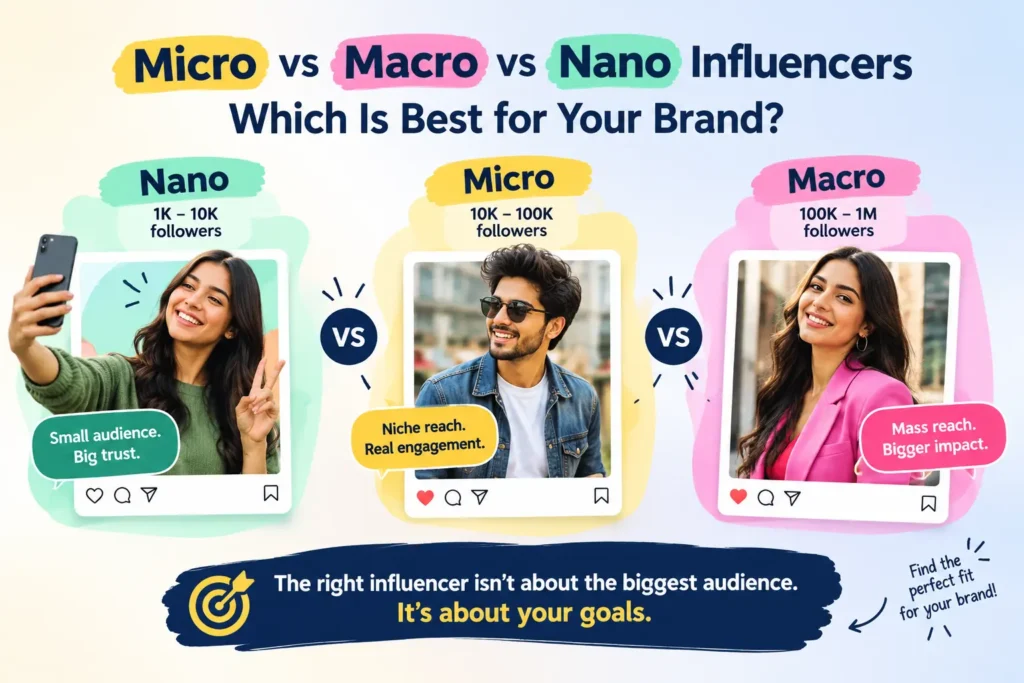
Choosing an influencer is no longer as simple as finding someone with the biggest follower count. In 2026, brands are looking beyond vanity metrics and asking a much more important question: who can actually influence the people we want to reach? A creator with 8,000 followers may generate stronger conversations and more relevant purchases than someone with 800,000 followers, while a macro creator can still be extremely valuable when the objective is mass awareness. That is why understanding the difference between nano, micro, and macro influencers has become an important part of modern influencer marketing strategy.
India’s influencer marketing ecosystem has expanded significantly, with Kofluence’s 2026 research reporting annual influencer marketing spend of around ₹3,500 crore and data drawn from more than 750,000 creators on its platform. The same research indicates that brands are increasingly treating creator partnerships as a structured marketing channel rather than an occasional promotional activity. EY had earlier projected India’s influencer marketing sector to reach ₹3,375 crore by 2026, highlighting the growing importance of influencer campaigns in brand communication.
So, should your brand choose nano, micro, or macro influencers? The answer depends on your campaign objective, target audience, geography, industry, budget, platform, content requirements, and measurement strategy. Think of influencer tiers like different vehicles: a bicycle, a car, and a bus can all take you somewhere, but the right choice depends on where you are going, how many people are travelling, and how much you want to spend. Let’s break down each influencer category and build a practical framework for making the right choice.
Why Influencer Tier Matters in 2026
Influencer tiers matter because follower count affects more than potential reach. It can influence the relationship between creator and audience, content economics, campaign scalability, operational complexity, and the type of marketing objective the creator is naturally suited to support. A brand launching a new product across India may need broad exposure, whereas a Pune-based restaurant opening a new outlet may benefit more from a group of local creators whose audiences actually live nearby. Treating these two campaigns identically simply because both use Instagram would be a strategic mistake.
The creator economy has also become more sophisticated. Kofluence’s 2026 research reports that 76.6% of brands surveyed have run partnership ads with influencers, while 62.1% say they favour longer-term creator partnerships. This tells us something important: brands are increasingly thinking beyond a single sponsored post. The creator is becoming part of a broader content, paid media, commerce, and community strategy.
At the same time, there is no universal definition of influencer tiers. Some agencies classify micro creators as 10,000–100,000 followers, while other datasets divide the range differently. For example, current Indian industry benchmarks commonly place nano creators around 1K–10K, micro creators around 10K–100K, and macro creators somewhere from 100K to 1M, depending on the classification system. Therefore, follower count should be treated as a starting point, not the final selection criterion. A creator’s average views, engagement quality, audience location, demographics, niche relevance, content quality, and conversion history can matter much more than the number displayed beneath their profile name.
What Are Nano, Micro, and Macro Influencers?
At the simplest level, influencer tiers describe creators according to the size of their audience. Nano influencers generally have around 1,000–10,000 followers, micro influencers commonly fall between 10,000 and 100,000, and macro influencers can range from approximately 100,000 to 1 million followers. These are practical industry ranges rather than universal legal or platform definitions, so agencies and platforms may use slightly different classifications.
But the real distinction is not just numbers. Nano creators often have highly concentrated communities and strong personal interaction. Micro creators tend to combine niche authority with meaningful scale, making them particularly useful when a brand wants both credibility and reach. Macro creators provide significantly greater potential exposure and can help brands create a larger cultural or awareness moment.
Nano Influencers
Nano influencers usually operate within smaller communities, often between 1,000 and 10,000 followers. Their greatest advantage is not scale but proximity. Their followers may perceive them more like knowledgeable peers, local personalities, hobby experts, or trusted community members than traditional celebrities. That can make nano creators particularly useful for hyper-local marketing, product sampling, community activation, UGC generation, and early campaign testing.
Current Indian benchmarks show nano creators can command comparatively modest fees, although pricing varies dramatically according to niche, deliverable, platform, content quality, usage rights, and audience. Kofluence’s 2026 research cites Instagram earnings of approximately ₹1,200–₹13,000 per nano collaboration, while other 2026 market benchmarks place Reel pricing in similar broad low-thousands ranges.
For a small business, nano influencers can create a powerful local presence without consuming the entire marketing budget. Imagine launching a new café in one neighbourhood. Instead of paying one large creator to tell an entire city about the café, you could collaborate with several local food, lifestyle, college, or community creators. The combined content may create repeated exposure among people who can realistically visit the business.
Micro Influencers
Micro influencers generally sit in the 10,000–100,000 follower range and represent one of the most strategically useful segments for many brands. They often have a defined niche, such as beauty, fitness, fashion, finance, technology, food, parenting, travel, gaming, or regional entertainment. Their audiences are large enough to provide meaningful reach but focused enough that the creator can maintain a recognizable relationship with their community.
Kofluence reported in its 2025 research that 52% of marketers preferred micro influencers for regional and hyper-local campaigns. That preference makes sense because micro creators can offer a useful middle ground between audience scale and creator credibility. A micro creator may also be easier to work with than a high-profile creator when the brand requires multiple content revisions, regional language adaptation, product demonstrations, or long-term collaboration.
Micro influencers are particularly useful for brands that need a combination of awareness, engagement, consideration, and performance. A beauty brand, for example, might work with several micro creators to demonstrate a product in different skin types or routines. A fintech brand might choose creators who have established authority in personal finance rather than simply choosing someone with the largest possible audience.
Macro Influencers
Macro influencers generally have audiences ranging from 100,000 to 1 million followers, although the exact boundary varies across industry sources. Their biggest advantage is scale. A successful macro creator can put a product, campaign, launch, or brand message in front of a substantial audience quickly, making this tier particularly relevant for awareness campaigns and major launches.
Macro creators also have the potential to provide a stronger association between the creator’s public identity and the brand. That can be valuable when a company wants to build familiarity or create a campaign moment around a new product. However, greater reach does not automatically mean greater conversion. As audience size increases, engagement rates often decline, although this pattern varies significantly by creator, category, platform, and content format.
Current Indian research demonstrates the price gap clearly. One 2026 market benchmark places Instagram Reel pricing broadly around ₹40,000–₹2,00,000+ for macro creators, while other datasets show even wider ranges depending on whether a creator is classified as mid-tier, macro, or mega. The important lesson is that a macro collaboration should be purchased for a specific strategic reason—not simply because the creator has a large number next to their name.
Nano vs Micro vs Macro Influencers at a Glance
The easiest way to understand the three tiers is to compare their typical characteristics. The figures below are planning benchmarks, not fixed industry prices, because influencer rates can change significantly according to niche, content format, audience quality, language, geography, exclusivity, usage rights, and campaign duration. Current Indian sources also use somewhat different tier boundaries, so brands should always confirm how an agency or platform defines each category.
| Factor | Nano Influencers | Micro Influencers | Macro Influencers |
|---|---|---|---|
| Typical followers | 1K–10K | 10K–100K | 100K–1M |
| Primary strength | Trust & community | Niche reach + credibility | Large-scale awareness |
| Engagement potential | Often high | Usually strong | Usually lower than smaller tiers |
| Audience relationship | Highly personal | Community-based | More broadcast-oriented |
| Typical campaign use | Local, UGC, testing | Consideration, engagement, performance | Launches, awareness, reach |
| Relative cost | Low | Medium | High |
| Scalability | High through volume | High | High through individual reach |
| Operational workload | High when using many creators | Moderate | Lower creator count |
| Best for | Local/niche campaigns | Balanced campaigns | Mass awareness |
| Main challenge | Limited individual reach | Creator selection | Cost and efficiency |
The comparison reveals why asking “Which influencer is best?” is the wrong starting point. Instead, ask, “Which creator tier is most appropriate for the job I need done?” A nano creator may be excellent for one campaign and completely unsuitable for another. A macro creator may appear expensive on a cost-per-post basis but still make sense when the objective is generating broad awareness around a national product launch.
Engagement Rate vs Reach: What Should Brands Prioritize?
One of the biggest mistakes in influencer marketing is treating followers as the ultimate KPI. A creator with 500,000 followers does not necessarily deliver 500,000 meaningful exposures, and a creator with 7,000 followers does not necessarily have an insignificant marketing impact. What matters is the quality and relevance of the audience, how many people actually see the content, how they respond, and whether those responses contribute to the campaign objective.
Current Indian benchmarks often show a general relationship between audience size and engagement. For example, one 2026 dataset reports approximately 6.8% engagement for nano creators, 4.1% for micro creators, 1.6% for macro creators, and 1.1% for mega creators based on its methodology. Another Indian research source places nano engagement around 6–10% and micro engagement around 4–7%. These figures should not be treated as universal averages because engagement calculation methods differ across platforms and datasets.
For brands, the smarter approach is to evaluate engagement quality, not simply engagement percentage. Are comments meaningful? Are followers asking questions? Are people tagging friends? Does the audience match your customer profile? Does the creator generate consistent views across multiple posts rather than one viral spike? These questions can tell you far more about influence than follower count alone.
How Much Do Nano, Micro, and Macro Influencers Cost in India?
Influencer pricing in India varies so widely that quoting one fixed number can be misleading. A creator’s fee can change based on platform, niche, follower count, average views, engagement, content format, production quality, exclusivity, turnaround time, usage rights, paid amplification, geographic targeting, and campaign duration. A finance creator and a lifestyle creator with the same follower count may charge completely different amounts because the commercial value of their audiences is different.
For 2026, published Indian market benchmarks provide useful planning ranges. One current pricing report estimates Instagram Reel fees at approximately ₹2,000–₹8,000 for nano creators, ₹8,000–₹40,000 for micro creators, and ₹40,000–₹2,00,000+ for macro creators. Another current benchmark gives broader ranges, including ₹2,000–₹12,000 for nano Reels, ₹8,000–₹80,000 for micro creators, and ₹85,000–₹8 lakh for macro creators depending on classification and creator characteristics.
| Influencer Tier | Indicative 2026 India Reel Range | Typical Strategic Role |
|---|---|---|
| Nano | ₹2,000–₹12,000+ | Community, local reach, testing |
| Micro | ₹8,000–₹80,000+ | Engagement, consideration, performance |
| Macro | ₹40,000–₹2,00,000+ and higher | Awareness and major launches |
The key point is that the cheapest creator is not automatically the most cost-effective creator. A ₹5,000 collaboration producing 200 genuine website visits may be more valuable than a ₹1 lakh collaboration producing millions of impressions with little action. Brands should therefore calculate metrics such as CPM, CPV, CPE, cost per click, cost per lead, conversion rate, revenue attributed, and return on ad spend where tracking is available.
Which Influencer Tier Fits Your Marketing Goal?
Your campaign objective should determine your creator mix. If you start with the influencer rather than the goal, you can easily end up building a campaign around a creator’s audience instead of your customer’s needs. Start by defining what success means: awareness, reach, engagement, content creation, website traffic, app installs, leads, sales, store visits, or long-term brand building.
EY’s India research specifically emphasizes aligning influencer selection criteria with campaign objectives and identifies engagement rate and target-audience quality among the leading selection considerations. This is a useful principle because a creator who is perfect for awareness may not be the right choice for direct response.
Influencers for Brand Awareness
If your primary objective is maximum awareness, macro influencers can be useful because their audience size allows a campaign to reach a large number of people quickly. They can be especially relevant for product launches, major announcements, seasonal campaigns, entertainment promotions, national brand initiatives, and moments where scale matters.
But macro should not automatically mean “one creator.” A more sophisticated awareness campaign may combine one or two larger creators with multiple micro creators. The macro creator creates the initial attention while smaller creators reinforce the message through different communities and content styles.
This approach resembles launching a movie: one major trailer can generate broad attention, but reviews, conversations, short clips, community discussions, and word-of-mouth keep the story moving. In influencer marketing, reach creates the opening, while multiple creator voices can help extend the campaign.
Influencers for Engagement and Community Building
When your objective is engagement, trust, conversation, or community building, micro and nano creators can become particularly valuable. Their audiences are often more concentrated, and the creator may have more frequent interaction with followers. This can be useful for brands selling products where people need recommendations before making a purchase.
Regional and hyper-local campaigns are another strong use case. Kofluence’s research highlights growing importance for Tier-2 and Tier-3 creators and vernacular content, while its 2026 research notes that regional resonance is becoming increasingly important in India’s diverse creator ecosystem.
For example, a brand entering Marathi-speaking markets in Maharashtra may achieve more relevant engagement from several Marathi-speaking micro or nano creators than from one English-speaking macro creator with a larger national audience. The question is not “How many people saw it?” but “How many of the right people saw it and cared?”
Influencers for Leads, Sales, and Conversions
For performance marketing, follower count becomes even less important. You need creators whose audiences have a demonstrated tendency to act. That action could mean clicking a link, using a coupon code, visiting a store, submitting a lead form, downloading an application, or purchasing a product.
Micro and nano creators can be effective for this purpose because their audiences may be closely aligned with a niche or geographic community. However, macro creators can also generate conversions when there is strong product-market fit and a trusted creator-product relationship. The right answer depends on the product and tracking system.
For conversion campaigns, insist on measurable mechanisms wherever practical: unique discount codes, UTM links, affiliate links, creator-specific landing pages, WhatsApp keywords, QR codes, or platform conversion tracking. Once you have campaign data, you can compare creators on cost per conversion and revenue, rather than relying on follower counts.
Does Your Industry Change the Right Influencer Tier?
Absolutely. The ideal influencer tier can change dramatically from one industry to another. A fashion brand may benefit from visually strong creators who can demonstrate styling ideas, while a B2B software company may need niche experts whose audiences are much smaller but commercially relevant. A restaurant needs local influence, whereas a consumer electronics company may want national reach and specialist technology reviewers.
Beauty, fashion, food, fitness, travel, and lifestyle often work naturally with nano and micro creators because consumers actively seek recommendations and demonstrations. Finance, technology, automobiles, healthcare-related categories, and professional services may place greater emphasis on expertise and audience credibility. In these categories, a smaller creator with strong subject authority may be more useful than a general entertainment creator with millions of followers.
Geography is equally important in India. The country is not one homogeneous audience. Language, city, culture, purchasing power, local preferences, and community behaviour can differ dramatically. Kofluence’s research specifically points to regional creator growth and vernacular content as important parts of India’s evolving influencer ecosystem.
This is why audience relevance should be treated as a multiplier. If a creator has 20,000 followers and 60% are relevant to your target market, that can be more commercially useful than 500,000 followers where only a small fraction match your customer profile.
Instagram, YouTube, or Both?
Choosing the influencer tier without considering the platform is another common mistake. Instagram is particularly useful for visual discovery, Reels, Stories, product demonstrations, lifestyle content, and quick interactions. YouTube can be stronger when consumers need deeper explanations, reviews, tutorials, comparisons, or longer-form storytelling. A creator who performs exceptionally well on one platform may not have the same influence on another.
EY’s India research identifies Instagram and YouTube as the most preferred platforms for consuming influencer content, while also noting that other platforms serve specific consumer cohorts. This means brands should not simply copy the same campaign across every channel.
Consider the customer journey. Someone buying a ₹499 beauty product may be comfortable making a quick decision after watching a Reel. Someone considering a ₹1 lakh technology product may want a detailed YouTube review. In the first scenario, short-form micro creators could be highly useful. In the second, a specialist YouTube creator may provide much greater value even if their follower count looks smaller.
The best platform is therefore the one that matches how your audience discovers, evaluates, and purchases your product.
Should Brands Mix Nano, Micro, and Macro Influencers?
A mixed-tier influencer strategy can be extremely useful because different creator levels can perform different jobs within the same campaign. Instead of asking whether nano is better than micro or micro is better than macro, consider building a marketing funnel in which each tier contributes something different.
A hypothetical product launch might use one macro creator to create initial awareness, 10 micro creators to explain the product from different perspectives, and 30 nano creators to generate local conversations and user-generated content. The macro creator supplies scale. The micro creators provide credibility and detailed storytelling. The nano creators create frequency and community-level visibility.
Kofluence’s 2026 report notes that brands are increasingly moving toward structured creator relationships and that long-term partnerships are gaining importance. This supports the idea of thinking beyond one-off posts. Instead of spending the entire budget on one large campaign moment, brands can create an ecosystem of creators who repeatedly communicate the product.
The exact ratio should depend on the objective. There is no universal formula such as “50% micro, 30% nano, 20% macro.” Build the mix around the job each creator needs to perform and then use campaign data to adjust the allocation.
How to Choose the Right Influencers for Your Campaign
Start with your customer, not Instagram’s search bar. Define your target audience by age, gender where relevant, location, language, interests, purchasing behaviour, and problem or need. Then define the campaign objective and the action you want the audience to take. Once these two elements are clear, you can identify creators whose audiences overlap with your customer profile.
A useful influencer evaluation framework includes:
- Audience relevance: Does the creator actually reach your target customers?
- Engagement quality: Are followers genuinely interacting with the content?
- Average views: Are recent posts consistently receiving reasonable exposure?
- Content quality: Can the creator produce content that suits your brand?
- Audience geography: Are followers concentrated in the locations you serve?
- Language: Can the creator communicate naturally with your intended audience?
- Brand safety: Does the creator’s content history align with your values?
- Past campaigns: Has the creator worked successfully with similar brands?
- Conversion ability: Can the creator demonstrate measurable actions?
- Commercial terms: Do the deliverables, usage rights, exclusivity, and price make sense?
Also look beyond the last viral Reel. Review a creator’s recent content over several weeks or months. A creator with one 5-million-view video and ten posts receiving very low views may not provide the consistency your campaign needs. Strong influencer selection is less like picking a celebrity from a poster and more like hiring a salesperson: you want evidence that the person can communicate, connect, and deliver.
Common Mistakes Brands Make When Choosing Influencer Tiers
The first mistake is choosing creators purely by follower count. Bigger numbers can look impressive in a presentation, but they do not automatically translate into better business results. The second mistake is assuming that high engagement automatically means high sales. Engagement is useful, but likes and comments are not the same thing as purchases.
Another common mistake is using the same creator strategy for every campaign. A local store opening, national product launch, app-install campaign, luxury product launch, and B2B lead-generation campaign should not necessarily use the same influencer tier. Each has a different customer journey.
Brands also frequently underestimate operational costs. Ten nano creators may be affordable individually, but managing ten briefs, contracts, content reviews, revisions, invoices, disclosures, and reporting processes requires considerably more coordination than working with one large creator. The reverse problem also occurs: brands sometimes pay heavily for one macro creator when the campaign actually requires multiple niche voices.
A final mistake is ignoring content usage rights. A creator’s posting fee and the right to reuse that content in paid advertising are not always the same thing. Current 2026 pricing research indicates that paid usage can add significant costs, with one benchmark reporting typical uplifts of approximately 30–100% for paid usage rights. Always clarify whether the brand can repost, run ads through the creator’s content, edit the asset, use it on websites, or retain it beyond the campaign period.
How to Measure Influencer Campaign Performance
A successful influencer campaign needs a measurement framework before the campaign begins. Otherwise, brands often finish with screenshots of likes and comments but no clear understanding of whether the investment generated business value.
For awareness campaigns, monitor reach, impressions, video views, view-through rate, frequency, CPM, share of voice, and brand-search lift where measurable. For engagement campaigns, monitor engagement rate, meaningful comments, shares, saves, profile visits, and audience sentiment. For performance campaigns, move further down the funnel and measure clicks, landing-page visits, leads, conversions, revenue, CPA, ROAS, and repeat purchases.
| Campaign Objective | Useful KPIs |
|---|---|
| Awareness | Reach, impressions, views, CPM |
| Engagement | Comments, shares, saves, engagement rate |
| Traffic | Link clicks, CTR, website sessions |
| Lead generation | Leads, CPL, qualified leads |
| Sales | Purchases, CPA, revenue, ROAS |
| UGC | Content volume, asset quality, usable content rate |
| Local activation | Store visits, QR scans, coupon redemptions |
| Brand building | Search lift, sentiment, branded mentions |
Most importantly, compare creators against one another using the same measurement logic. If one creator generates 50,000 views and another generates 20,000, the first is not automatically better. If the first costs ₹75,000 and the second costs ₹15,000, the picture changes. Performance measurement turns influencer marketing from a popularity contest into a genuine marketing discipline.
Conclusion
There is no universal winner between nano, micro, and macro influencers. Each tier solves a different marketing problem. Nano influencers can provide intimate community connections, local relevance, affordable testing, and authentic UGC. Micro influencers can provide a powerful combination of niche authority, engagement, reach, and performance potential. Macro influencers can provide scale, visibility, launch momentum, and broad awareness.
For many brands, the most practical strategy is not choosing one tier exclusively but creating a purpose-built influencer mix. Start with the objective, identify the audience, select creators based on relevance and performance potential, establish clear KPIs, and then allocate budget according to what the data tells you. Current Indian research reinforces the importance of objective-led creator selection, audience quality, engagement, regional relevance, and longer-term relationships rather than relying solely on follower count.
If you are a small or emerging brand, nano and micro creators can provide an efficient way to test messaging and discover which communities respond to your product. If you are launching nationally, macro creators can provide the scale needed to create awareness, while micro and nano creators can add depth and frequency. The strongest campaigns often treat influencer marketing as an ecosystem rather than a single transaction.
The real question, therefore, isn’t “Micro vs Macro vs Nano: Which is best?” It is “Which creator tier—or combination of tiers—is best suited to my audience, objective, budget, and customer journey?” Once you answer that question, influencer selection becomes considerably clearer.
FAQs:
1. Are nano influencers better than macro influencers?
Neither tier is universally better. Nano influencers generally offer smaller but more concentrated audiences, while macro influencers offer significantly greater potential reach. The right option depends on whether the campaign prioritizes community engagement, local relevance, conversions, or large-scale awareness.
2. Are micro influencers good for small businesses in India?
Micro influencers can be particularly useful for small and growing businesses because they can combine niche relevance with meaningful audience scale. Local language and location-specific creators can be especially valuable when the business serves a particular city or region.
3. How many followers does a micro influencer have?
A commonly used Indian industry classification places micro influencers in the 10,000–100,000 follower range. However, definitions vary across agencies and platforms, so follower count should always be considered alongside engagement, average views, audience demographics, and niche relevance.
4. How much does an influencer cost in India in 2026?
There is no fixed rate. Current published benchmarks place nano Instagram Reels roughly in the low-thousands range, micro Reels broadly from several thousand to tens of thousands of rupees, and macro collaborations from tens of thousands into lakhs depending on the creator and deliverables. Usage rights, exclusivity, niche, platform, content format, and campaign duration can substantially change the final price.
5. Should a brand use multiple influencers instead of one big influencer?
A multi-influencer strategy can be useful when a brand wants to combine reach, credibility, regional relevance, content volume, and performance. A campaign might use macro creators for awareness and micro or nano creators for community-level engagement. The ideal combination should be determined by the campaign objective and measured results rather than a fixed formula.