
Deep Learning Uncovered: The Brain Behind Modern AI
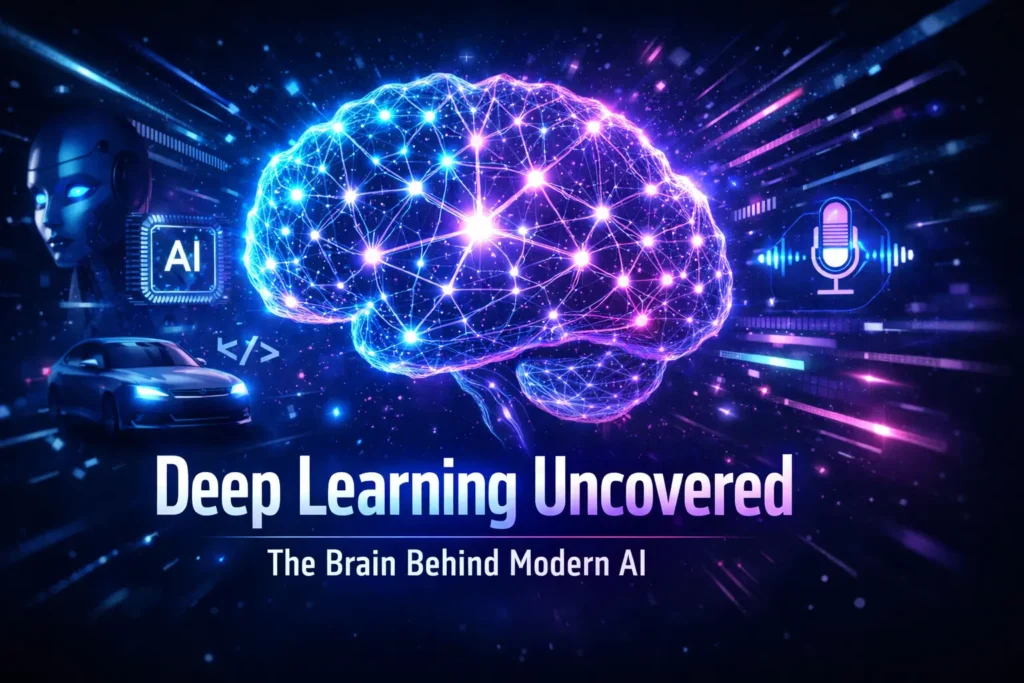
Artificial Intelligence (AI) is no longer a futuristic concept—it’s already shaping the way we live, work, and interact with technology. From voice assistants and recommendation systems to self-driving cars and advanced medical diagnostics, AI is everywhere. At the heart of this revolution lies a powerful technology called Deep Learning.
In this comprehensive guide, we’ll explore what deep learning is, how it differs from machine learning, its benefits, and why it is driving the modern AI transformation. We’ll also include trending keywords and FAQs to help you fully understand this game-changing technology.
What is Deep Learning?
Deep Learning is a subset of Artificial Intelligence (AI) and Machine Learning (ML) that uses artificial neural networks to mimic the way the human brain processes information.
These neural networks consist of multiple layers (hence “deep”) that enable systems to:
- Learn from large datasets
- Identify patterns automatically
- Make intelligent decisions with minimal human intervention
🧠 How It Works:
Deep learning models use:
- Input Layer – Receives data (images, text, audio)
- Hidden Layers – Process and analyze data
- Output Layer – Produces the result (prediction or classification)
👉 Example:
When you upload a photo on social media, deep learning algorithms can automatically detect faces, objects, and even emotions.
Why Deep Learning is Trending in 2026
Deep learning is one of the most searched and discussed topics in AI today. Some trending keywords include:
- Deep Learning AI
- Generative AI models
- Neural Networks explained
- AI automation tools
- ChatGPT technology
- Computer Vision AI
- Natural Language Processing (NLP)
- AI in healthcare
- AI future trends
- Machine Learning vs Deep Learning
The rise of Generative AI, like ChatGPT and AI image generators, has brought deep learning into the spotlight like never before.
Difference Between Machine Learning and Deep Learning
Although often used interchangeably, Machine Learning and Deep Learning are not the same.
📊 Key Differences:
| Feature | Machine Learning | Deep Learning |
|---|---|---|
| Definition | AI that learns from data using algorithms | Advanced ML using neural networks |
| Data Requirement | Works with small to medium datasets | Requires massive datasets |
| Feature Engineering | Needs human input | Automatically learns features |
| Complexity | Simpler models | Complex, multi-layer networks |
| Speed | Faster to train | Slower but more accurate |
| Use Cases | Spam detection, recommendations | Image recognition, voice assistants |
👉 Simple Explanation:
- Machine Learning is like teaching a child using examples.
- Deep Learning is like the child learning on their own by observing patterns.
Benefits of Deep Learning
Deep learning has transformed industries by offering unmatched accuracy and automation. Here are the major benefits:
1. 🔥 High Accuracy
Deep learning models outperform traditional algorithms in tasks like image recognition and speech processing.
2. 🤖 Automation of Tasks
It reduces the need for manual intervention by automatically learning features from data.
3. 📊 Handles Big Data Efficiently
Deep learning thrives on large datasets, making it ideal for modern data-driven applications.
4. 🧠 Mimics Human Intelligence
Neural networks simulate human decision-making, making systems smarter over time.
5. 🌍 Wide Range of Applications
Used in:
- Healthcare (disease detection)
- Finance (fraud detection)
- E-commerce (recommendation engines)
- Autonomous vehicles
- Chatbots and virtual assistants
6. ⚡ Real-Time Processing
Deep learning enables real-time analysis in applications like facial recognition and voice commands.
Also Read:Best AI Tools for Content Writing Free (2026)
Real-World Applications of Deep Learning
Deep learning is not just theory—it’s actively shaping industries:
🏥 Healthcare
- Early disease detection
- AI-powered diagnostics
- Drug discovery
🚗 Self-Driving Cars
- Object detection
- Traffic prediction
- Autonomous navigation
🛒 E-Commerce
- Personalized recommendations
- Customer behavior analysis
🎙️ Voice Assistants
- Speech recognition
- Natural language understanding
🎨 Generative AI
- AI content writing
- Image and video generation
- Music creation
Challenges of Deep Learning
Despite its power, deep learning comes with some limitations:
- Requires large datasets
- High computational cost
- Needs powerful hardware (GPUs)
- Can be difficult to interpret (“black box” problem)
Future of Deep Learning
The future of deep learning is incredibly promising. Experts predict:
- Smarter AI systems with human-like reasoning
- Expansion of Generative AI tools
- AI integration in everyday devices
- Growth in AI automation across industries
Deep learning will continue to be the backbone of AI innovation in the coming years.
Frequently Asked Questions (FAQs)
1. What is deep learning in simple words?
Deep learning is a type of AI that teaches computers to learn and think like humans using neural networks.
2. Is deep learning better than machine learning?
Deep learning is more powerful for complex tasks like image and speech recognition, but machine learning is still useful for simpler problems.
3. Why is deep learning important?
It enables advanced AI applications such as self-driving cars, virtual assistants, and medical diagnosis systems.
4. What are examples of deep learning?
Examples include:
- Face recognition
- Voice assistants (like Alexa, Siri)
- Chatbots
- AI image generators
5. Does deep learning require coding?
Yes, basic knowledge of programming (like Python) is usually required to build deep learning models.
6. What is the future scope of deep learning?
The future includes smarter AI systems, automation, and widespread use across industries like healthcare, finance, and education.
Conclusion
Deep learning is truly the brain behind modern AI, driving innovations that were once considered science fiction. From transforming industries to enhancing everyday experiences, its impact is undeniable.
As we move further into the era of AI transformation, understanding deep learning is no longer optional—it’s essential. Whether you’re a student, professional, or tech enthusiast, staying updated with this powerful technology will give you a competitive edge in the digital world.